
Certificates, Curiosity, and the Disappearance of Depth in Karate.
Posted by ADAM CARTER on JAN 18, 2026
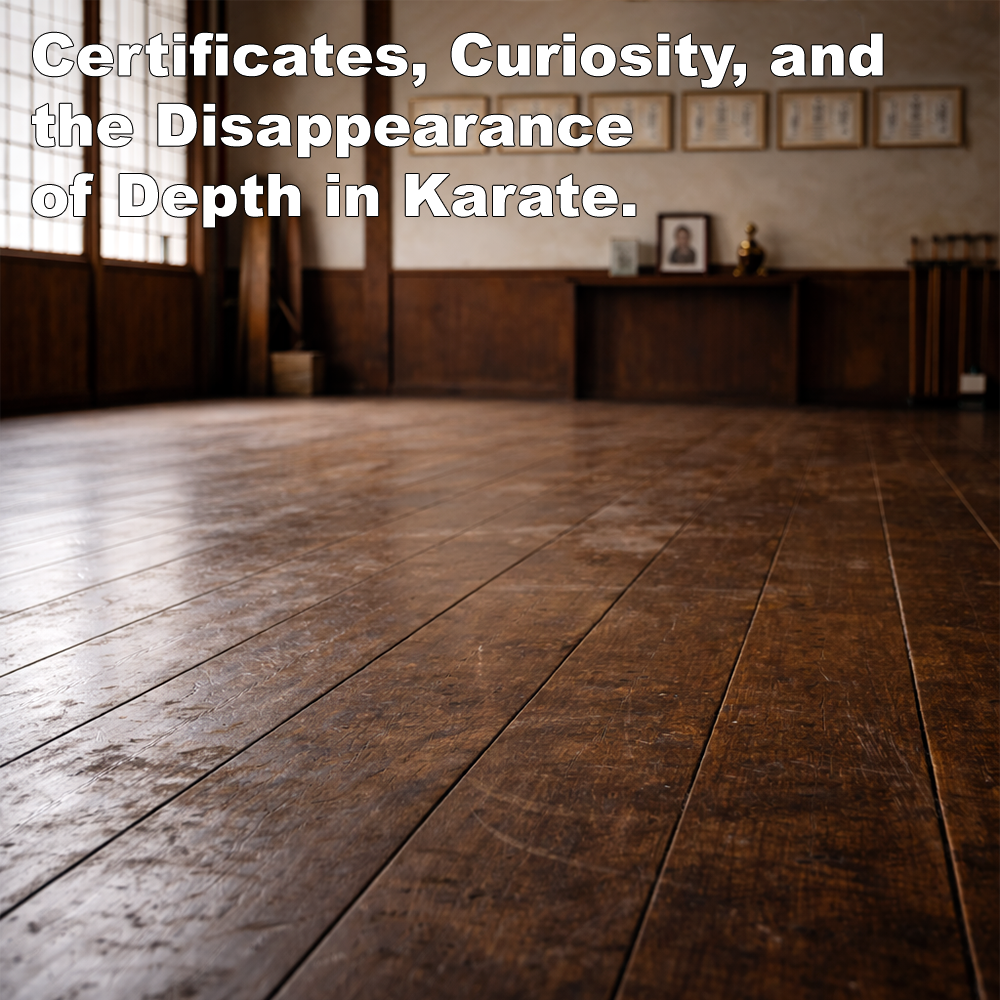
Certificates, Curiosity, and the Disappearance of Depth in Karate.
There is a modern belief that achievement is something you can hold in your hand – a certificate, a diploma, a grade, a title, a rank. Something printed, stamped, and signed that proves you have arrived. It’s a comforting illusion, and it has taken root in karate.
The logic is simple. If the box is ticked, the work must be complete. If the test is passed, the knowledge must be real. If the rank is awarded, the skill must be present.
Karate does not bend to that logic. It never has.
Karate was built on practice, not performance. On understanding, not memorization. On curiosity, not compliance. Yet much of the modern karate world now mistakes certificates for competence, grades for progress, and performance for substance.
At the center of this confusion is the failure to distinguish between knowing about something and actually understanding it.
Knowing the syllabus is not understanding. Performing kata is not exploring what it contains. Passing a grading is not embodying the principles it claims to test. This is the difference between memorizing a map and walking the terrain.
Karate today is full of map-readers. People who can reproduce the choreography, demonstrate the official kumite, and meet the visible expectations of their organization. They know what will be rewarded. They know how to perform the role of a karateka.
But they have never walked the terrain.
They have never treated kata as a living textbook. They have never tested ideas under genuine pressure. They have never allowed uncertainty or failure to challenge what they were taught. They have memorized the map, but they have not travelled the landscape.
This is not entirely their fault. The culture around them rewards the wrong things.
Despite this, there are still practitioners who have done the work. They didn’t stop at what they were shown. They tested, failed, reflected, and revised. They are recognizable not by their credentials, but by the depth in their answers and the restraint in their claims.
Commercialization has turned rank into a subscription, created uniformity and stripped away subtlety. Senior grades are handed out without the decades of work they once represented. Somewhere along the way, depth became unfashionable.
The problem is that learning in depth is slow. It cannot be accelerated. It doesn’t photograph well. It doesn’t fit neatly into a syllabus. It requires time, pressure, correction, humility, and a willingness to be wrong. It requires curiosity, the very quality many systems quietly discourage.
Curiosity is uncomfortable. It leads people off the approved path and produces questions instead of obedience. It creates practitioners who want to know why, not just how. Who care about what works, not what looks right.
That curiosity is where depth and understanding comes from.
Not from titles or certificates, but from years of honest practice, failure and correction. From pressure, reflection, and revision, and from treating karate not as a performance to preserve, but as an inquiry to pursue.
Karate loses its depth when it becomes just a display. I believe it regains it when it becomes an investigation.
Yes, it’s nice to receive a certificate, a shiny new belt, even a title here and there. But on their own, it’s not the depth of understanding that we all should be aiming for.
Written by Adam Carter – Shuri Dojo


All rights reserved.