Predictable Responses Are Not Guaranteed Outcomes.
Posted by ADAM CARTER on JAN 24, 2026
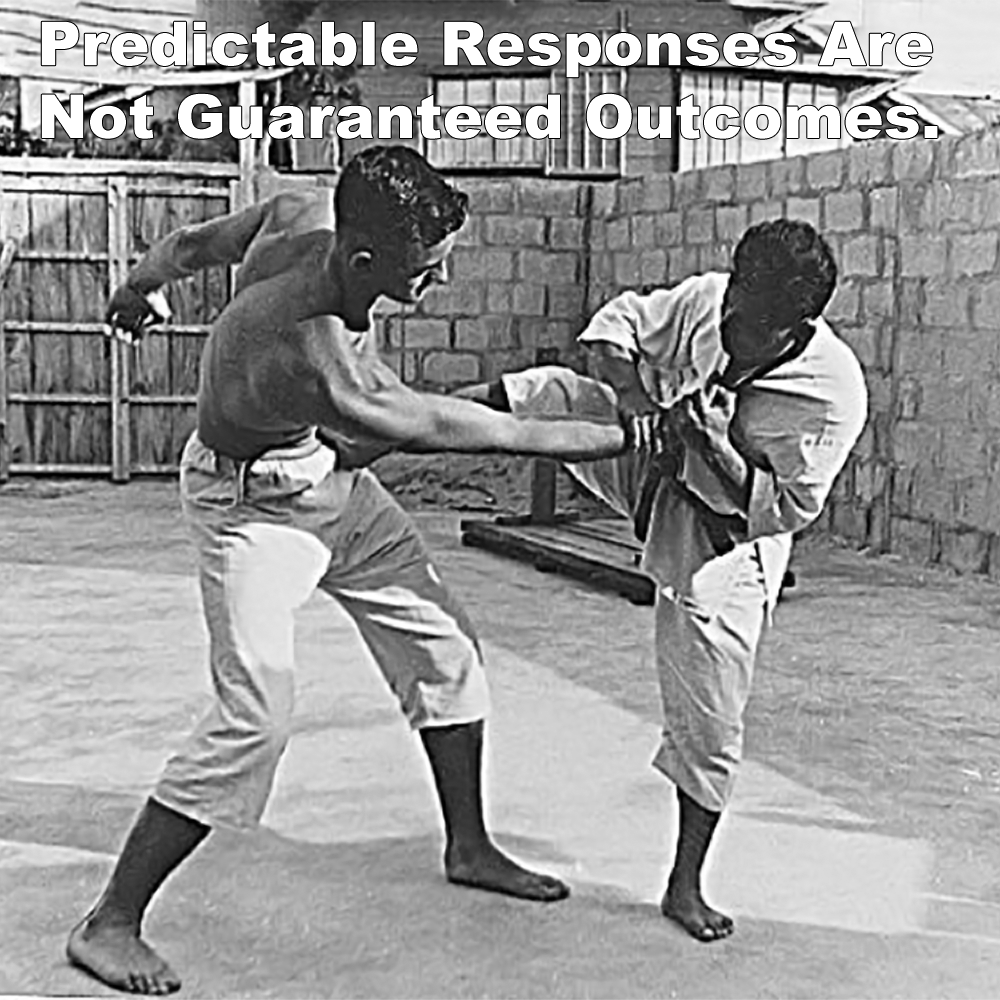
Predictable Responses Are Not Guaranteed Outcomes.
Following my recent article on bunkai and choreography, I found myself returning to the idea of “predictable responses”. It’s a familiar concept, and on the surface it makes sense. Certain actions often provoke certain reactions.
But often isn’t always. Nothing is guaranteed.
Yes, bodies respond to input. Strike, pull, disrupt balance – something will happen. Where we get into trouble is assuming that because a response is common, it can be relied upon, or treated as guaranteed.
This is where choreography returns, just in a subtler form.
Instead of the attacker freezing, the attacker now reacts – but reacts in the way we anticipated, because that reaction was decided in advance. The movement looks more believable, but it is still staged. The outcome was known before the input ever occurred.
This doesn’t mean familiar or common responses should be ignored. They matter. They are worth training, understanding, and teaching – I do exactly that myself. Recognizing likely reactions helps students orient themselves and gives them something concrete to work from. But I am careful to remind them, repeatedly, that these are assumptions, not guarantees. We train predictable responses as reference points, while staying honest about the fact that reality may not cooperate.
In controlled training, that can pass unnoticed. Outside the dojo, it doesn’t last long.
People are often intoxicated, unpredictable, or both. Alcohol and drugs change pain perception, balance, and emotional response. Reactions can be exaggerated, delayed, muted, or absent altogether. What you thought was reliable may not appear at all.
That doesn’t mean nothing happens. It means what happens may not look like what you expected.
This is why predictable responses need to be treated carefully. They describe tendencies, not obligations. They can inform decision-making, but they cannot guarantee outcomes.
Training breaks down in two places. One is when no reaction is acknowledged at all. The other is when the reaction is assumed and staged. Both remove the need to observe what is actually occurring.
A response must happen. Which response happens is never assured.
– Adam Carter


All rights reserved.