Choreography and the Dangers of Untested Confidence.
Posted by ADAM CARTER on JAN 14, 2026
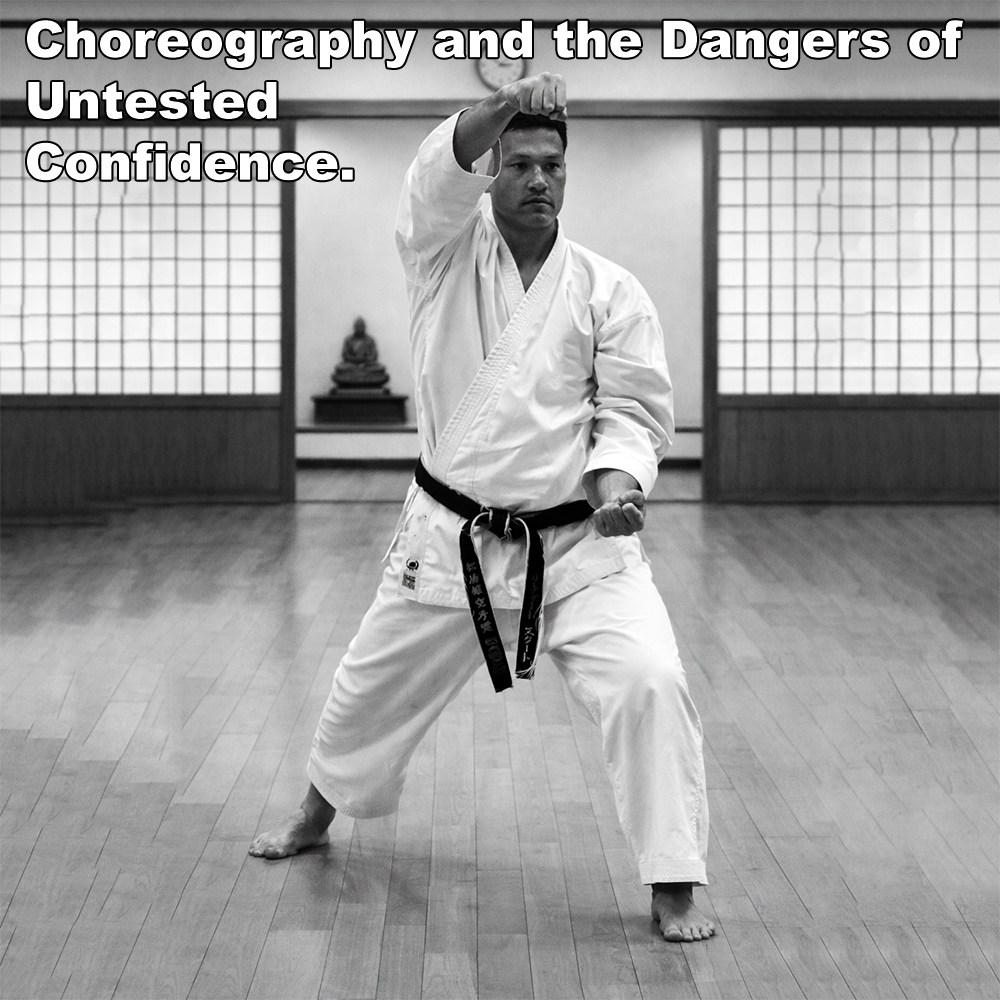
Choreography and the Dangers of Untested Confidence.
I was watching a video of a practitioner going through some self-defense techniques, presented as coming from a respected karate legacy.
To be honest, it would have been totally ineffective for that goal.
In a recent article, I explained how, as a young man in my early 20s, actively competing at a national level still wasn’t enough when I was set upon while out for a run.
Now, don’t get me wrong – I know a number of hugely successful tournament fighters who have worked in the security industry and been very effective and, most importantly, safe.
But not everyone is like these people. I was fit, athletic, and fast, but at that time I had not been exposed to the absolute, total violence that can follow a real-world attack.
Tournaments helped my technique and even gave me some degree of intimidation. But I always knew how safe and controlled it was. After all, no one was going to attack me with a knife.
You have to be careful not to become trapped in your own confirmation bias, as it can lead to overconfidence… and possibly danger. You have to understand the limitations of your practice.
Consensual fighting is not real violence. Agreeing to fight is nothing like being attacked on a dark, semi-lit street in the rain.
You have to look past that bias and see real-world violence for what it is. Once you do that, you may be able to help your students with more than just point-scoring or choreography.
Tournaments are fun, give you a sense of achievement, even a bit of bravado. But they’re not reality. Reality doesn’t agree to fight you. It doesn’t warn you. It doesn’t bow. And it can lead to overconfidence in your abilities.
I feel sometimes that some practitioners haven’t yet reached the point where they realize how many gaps exist in their knowledge.
They have impressive technical ability, enough to feel confident, but not enough experience to recognize how fragile that confidence really is. Their success has come in controlled conditions, so the gaps stay hidden. Chaos, fear, and non-compliance haven’t entered the equation yet. It’s still fun.
Real understanding doesn’t start until that confidence is challenged and collapses under pressure. That humbling, often uncomfortable moment usually arrives when you least expect it. In the dojo, it’s the moment the person you’re sparring with stops “playing along” and simply tackles you, ignoring karate techniques entirely. Suddenly, some part of your body hurts more than usual.
The clean lines of the dojo vanish, and you realize how much you don’t know. While that drop in confidence feels like a setback, it’s actually the most honest moment of training. It’s where you stop being a practitioner of a sport and start becoming a student of reality.
Back to the video I mentioned at the beginning of this article.
What troubled me, as well as the technique being shown, was the confidence behind it. The belief that what was being shown would work in that context. That confidence was real, but untested.
When belief is built inside controlled environments, nothing pushes back. Nothing exposes the gaps. The illusion holds, until reality does the testing.
This isn’t about criticizing an individual or a lineage. It doesn’t matter who you are, or how respected that lineage may be. When something is labelled “self-defense”, there is a responsibility to ensure it reflects reality, not choreography dressed up as something else. It’s about recognizing how easily belief can replace understanding.
Sometimes it’s good to feel incompetent in the dojo, so you aren’t proven incompetent in a crisis.
Written by Adam Carter – Shuri Dojo


All rights reserved.