
Real Violence Isn’t a Fight – And That Changes Everything.
Posted by ADAM CARTER on JAN 15, 2026
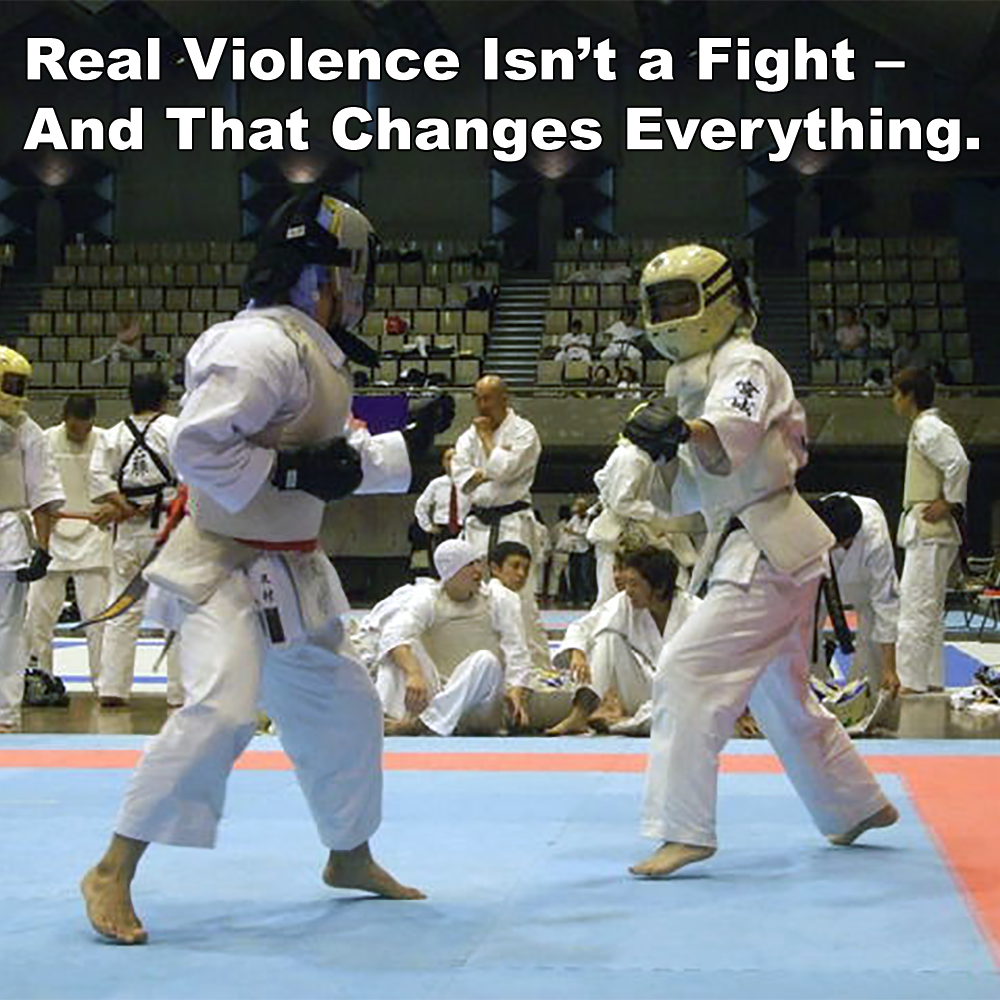
Real Violence Isn’t a Fight – And That Changes Everything.
In response to my recent article about a video of a practitioner demonstrating self-defense techniques, coming from a respected karate legacy, a comment stated that it is virtually impossible to train for real-world encounters, and that even MMA fighters lose in street situations.
Statements like this often sound insightful, but they hide a deeper problem – particularly for inexperienced readers.
The first issue is evidence. Claims like this are usually presented as self-evident truths, yet no supporting evidence is ever offered. “People still lose” is not proof that training is pointless. It only confirms what any honest practitioner already knows, that there are no guarantees. Real violence is chaotic, unfair, and unpredictable. No training removes risk entirely.
But training was never about certainty. It’s about preparation.
Saying that even trained fighters sometimes lose proves nothing more than saying people still drown while wearing life vests or crash cars while wearing seat belts. These tools don’t create invulnerability. They reduce vulnerability. That distinction matters, and it is precisely the part that gets lost in sweeping dismissals like this.
There is also a deeper misunderstanding at work. The assumption that preparing for real-world violence means preparing to “win a fight”. Real violence is not consensual. There is no agreement, no shared rule set. This is not a contest. Winning and losing are irrelevant. Safety and escape are the priorities.
Most experienced martial artists understand this. Awareness, avoidance, de-escalation, and leaving safely are not dramatic outcomes. They don’t show up in videos or stories. When nothing happens, people assume training failed. In reality, it often worked exactly as intended.
Ironically, the example of MMA fighters actually highlights the real point. Many sport fighters struggle outside their competitive context not because training is useless, but because their training was designed for a very specific environment.
I’ve said this many times in my articles – it’s about context. Rules, referees, timing, expectation, and mutual consent all shape behavior.
When those structures disappear, so does much of what the training relied on. I said as much in the original article, and that is precisely why training context matters.
So the real question is not whether training can guarantee success. It can’t. The real question is how people train, and what they believe their training is preparing them for.
Training for real-world situations does not mean rehearsing cinematic scenarios or pretending chaos can be controlled. It means acknowledging human limitation.
I explained in the original article how, when I was a young man, my breathing degraded under stress. Fine motor skills collapsed. Balance was compromised. Decision-making narrowed. Denying these realities creates false confidence. Training that works with these limitations rather than against them is where relevance begins.
Training for this kind of scenario often starts with small shifts in emphasis. Accepting uncertainty, working with unscripted partners, learning to disengage rather than dominate, and placing as much value on perception and judgement as on physical action. These things don’t look impressive, but they are foundational.
Dismissing all training because it cannot guarantee an outcome is not realism… it’s giving up. The martial arts are not insurance policies. They are tools. Poorly understood, they can mislead people. Properly approached, they increase awareness, restraint, and survivability.
Refusing to train because nothing is certain is like refusing to learn to swim because the sea is dangerous. It may sound pragmatic, but it leaves people less prepared, not more.
Written by Adam Carter – Shuri Dojo


All rights reserved.