When Function Comes First – Kata as Record, Not Puzzle.
Posted by ADAM CARTER on JAN 16, 2026
When Function Comes First – Kata as Record, Not Puzzle.
History is a strange thing. We have snippets here and there, sometimes probabilities creep in, but very little that is truly concrete. We study, we interpret, and some attempt to reverse engineer, but at the end of the day we can only work with what we have now.
There is an ongoing discussion around kata and bunkai – specifically whether kata came first and applications were added later, or whether two-person practice existed long before kata was formalized.
Much of the disagreement, in my view, comes from applying modern meanings to older practices without recognizing that both language and training methods shift over time.
Today, bunkai is usually understood as breaking down and analyzing kata, separating movements and assigning applications to them.
We have little choice today – it’s largely what remains. But that way of thinking assumes kata existed as a standalone practice that needed decoding afterwards. That assumption doesn’t really fit with how skills are learned when paired practice sits at the centre of training.
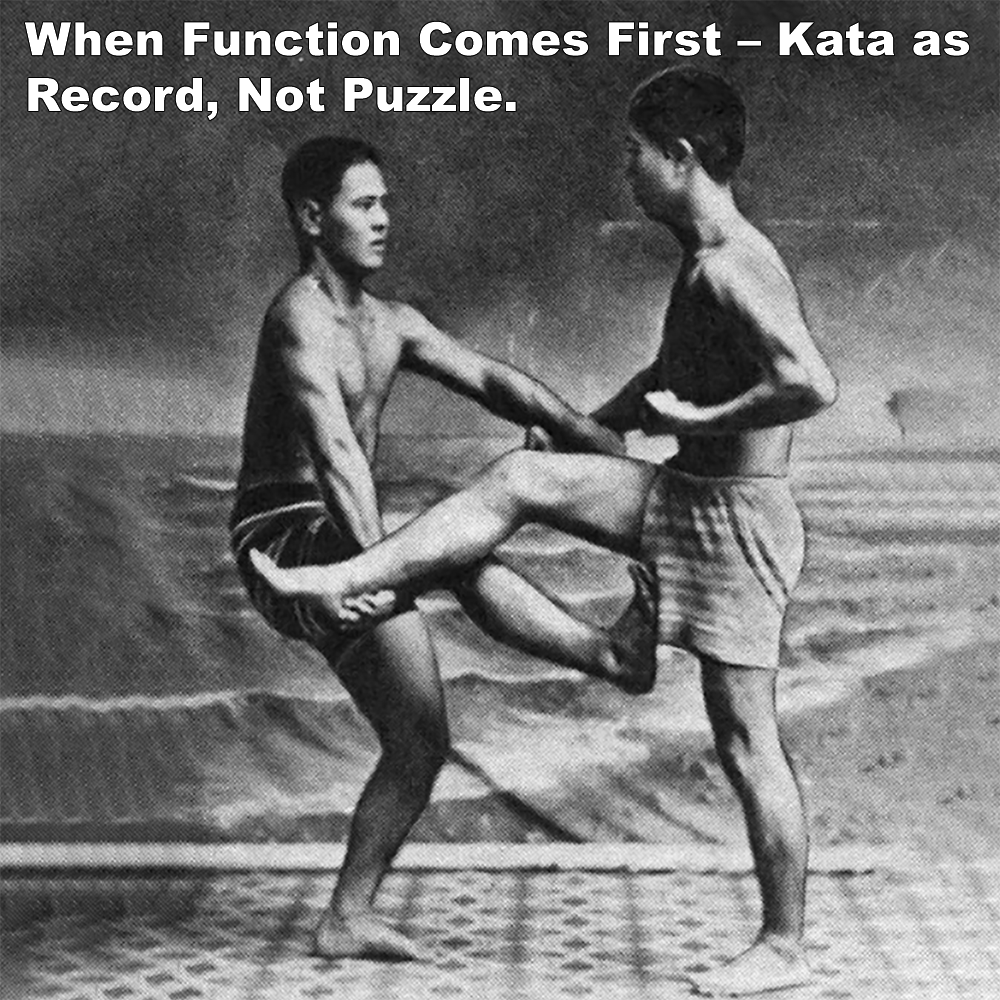
If someone is taught through two-person drills and physical exchanges with a partner, there is nothing to analyze. Function is learned directly through experience. In that situation, kata doesn’t require bunkai in the modern sense. It acts as a reminder, a mnemonic for lessons already understood.
This perspective also helps explain why historical accounts can appear contradictory. Claims that certain teachers did not “teach bunkai” sit uncomfortably beside clear examples and photographs of practical application being shown. That contradiction only exists if bunkai is assumed to have always meant what it tends to mean today. I don’t think it did.
I should be clear that this is my understanding, not a declaration of absolute truth. It’s shaped by my own experience, and by the work of researchers far more educated than I am who have spent years examining how karate was practiced, not just how it is described.
From that viewpoint, kata appears to have grown out of two-person drills and contextual practice, with solo forms coming later as a way to record and preserve knowledge. Kata doesn’t begin the process. It reflects it.
Today, of course, that paired context is reduced or lost, and analysis has become necessary. Bunkai then fills the gap. Over time, that analytical process becomes formalized, and eventually people begin to assume this was always the method. At that point, form leads and function follows, rather than the other way around.
I don’t think the word bunkai needs a single fixed definition for this discussion to make sense. In fact, assuming it has always meant the same thing is part of the problem. What matters is recognizing that training environments change, terminology drifts, and meaning evolves with context.
Based on my experience, and on what continues to make sense when viewed through lived practice rather than labels, kata works best when it is understood as a record of something already known, not a puzzle to be solved later.
This isn’t an argument I feel the need to win. It’s simply the framework that has continued to hold together the more I’ve tested it against practice, history, and common sense.
When experience comes first, explanation becomes unnecessary.
Written by Adam Carter – Shuri Dojo


All rights reserved.